




The Loom of the Latent Space
William Morris in the Age of Artificial Intelligence
IThe Second Enclosure: From the Steam Loom to the Latent Space
Were William Morris to step out of the limestone quietude of Kelmscott Manor and into the luminous, frictionless ether of the twenty-first century, he would not merely be horrified by generative artificial intelligence; he would recognize it, with bleak diagnostic clarity, as the final, metaphysical consummation of the nineteenth-century factory. In Morris’s Victorian nightmare, the power loom, the aniline dye vat, and the steam-driven cylinder press expropriated the artisan’s hand, reducing the laborer to an interchangeable appendage of iron and coal while flooding the drawing rooms of Europe with shoddy, soul-deadening simulacra of craft. Today, the silicon loom of the transformer architecture has accomplished a far more audacious enclosure: it has mechanized not merely the execution of the artifact, but the very gestation of its form. For the first time in the history of political economy, the machine does not wait for the designer’s cartoon before weaving the cloth. It hallucinates the acanthus leaf, the medieval woodcut, and the Kelmscott border ex nihilo, conjuring an infinite, weightless pastiche of “in the style of William Morris” at the whisper of a prompt.
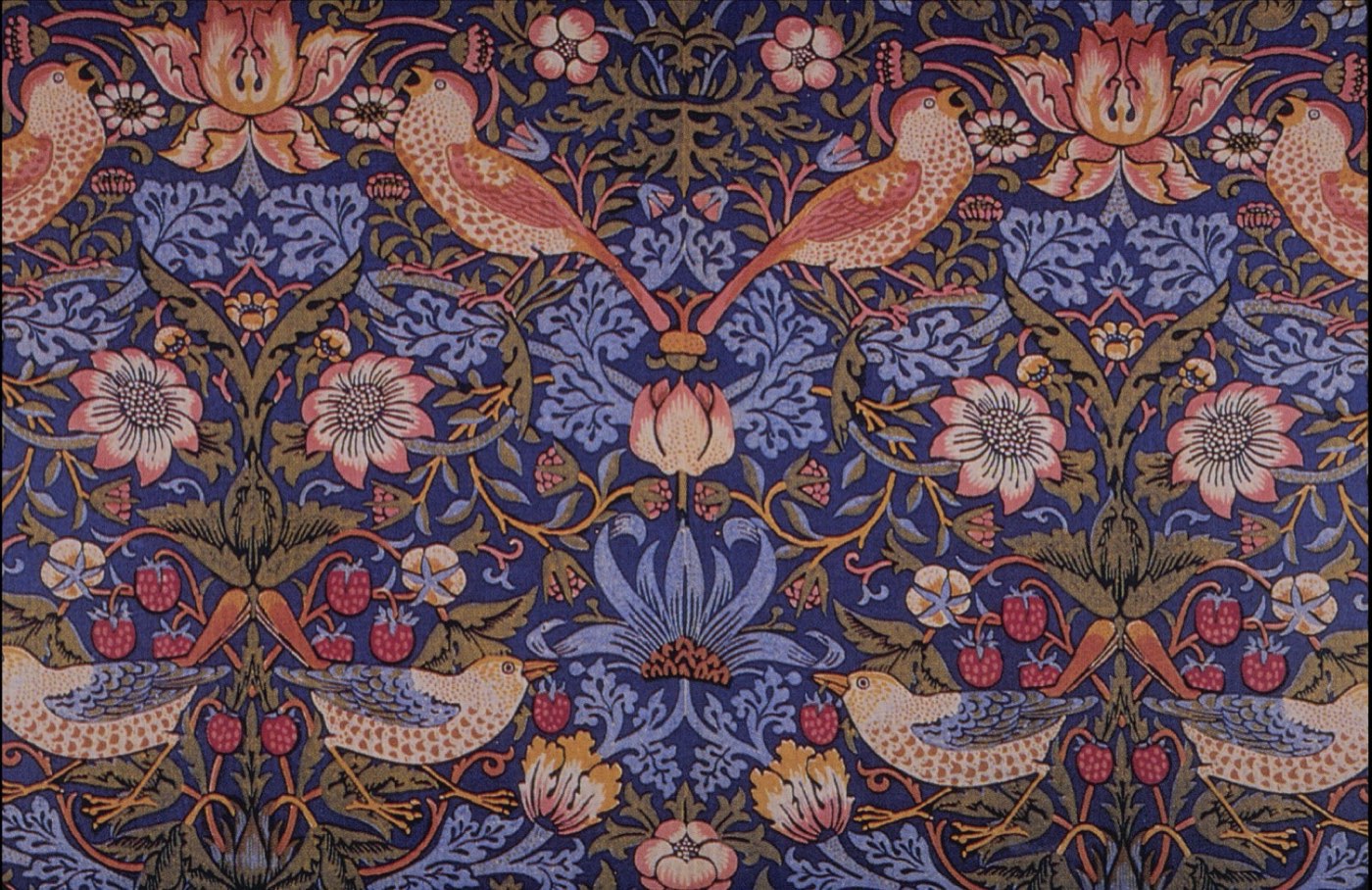
There is a grim, almost Hegelian irony in the fact that Morris’s own visual vocabulary—those lush, interlocking matrices of strawberry thieves, willow boughs, and trellis roses—should prove so effortlessly digestible by diffusion models. Morris conceived his repeating patterns as a disciplined celebration of organic law: a visual grammar rooted in the patient observation of English hedgerows, the structural constraints of the woodblock, and the honest chemistry of madder root, weld, and indigo. Yet in the high-dimensional geometry of the latent space, those patterns are stripped of their botanical patience, their woodblock registration, and their dye-vat provenance, flattened into a statistical texture that can be sprayed across a landing page or a print-on-demand tote bag in four seconds flat. What Marx called the fetishism of the commodity—the sleight of hand by which social relations between living human beings appear as autonomous relations between things—reaches its apotheosis in the generative prompt. The thing no longer even pretends to have been made by anyone; it arrives as immaculate, disembodied apparition, a surface severed from its genesis.
To treat Morris merely as a quaint Victorian aesthete whose decorative sensibilities happen to clash with our silicon modernity is to commit an act of profound hermeneutic vandalism. Morris was not an interior decorator who wandered into socialism by way of bad taste; he was a radical materialist of the aesthetic, a polymathic insurgent who diagnosed industrial capitalism not solely as an inequitable distribution of surplus value, though he came to despise it as that, but as an ontological catastrophe: the systematic expropriation of human pleasure from the act of labor. And it is precisely because our current technological moment targets the last remaining redoubts of unalienated, expressive work that Morris ceases to be an antiquarian curiosity and re-emerges as our most devastating contemporary.
IIThe Dialectics of Machinery: Useful Work, Useless Toil, and the Algorithmic Inversion
Any serious reckoning with Morris in the age of artificial intelligence must begin by rescuing him from the lazy caricature of the bearded Luddite—the sentimental medievalist who supposedly wished to smash every engine in Lancashire and march humanity backward into a thatched-roof feudalism. Nothing could be further from the truth. Morris’s philosophy of technology, articulated with lucid, unsentimental precision in his 1884 essay Useful Work versus Useless Toil and his 1888 lecture How We Live and How We Might Live, was rigorously dialectical. He did not abhor machinery per se; he abhorred the capitalist inversion of its telos.
In Morris’s taxonomy, human labor divides cleanly into two species: useful work, which carries within it the triple hope of rest, of product, and of pleasure in the very act of making; and useless toil, which produces either superfluous luxuries for the idle rich or shoddy “makeshifts” for the impoverished, while degrading the mind and body of the worker who performs it. In a rational, emancipated commonwealth, Morris argued, machinery would be enlisted solely to abolish the degrading, soul-crushing drudgery of existence—the stoking of furnaces, the hauling of waste, the hazardous extraction of minerals, the mind-numbing repetition of clerical accountancy. Far from rejecting automation, Morris explicitly imagined a future in which “immensely improved machinery” would shoulder the burden of all repugnant labor, thereby liberating human beings to devote their reclaimed hours to the slow, sensuous, autotelic pleasure of art, architecture, husbandry, and craft.
What makes the current epoch of generative AI so exquisitely grotesque through a Morrisian lens is its precise, almost parodic inversion of this prescription. Under the imperatives of late-stage techno-capitalism, we have erected vast, megawatt-devouring cathedrals of computation not to liberate the proletariat from useless toil, but to automate the very domain of useful work—the writing of verse, the illumination of manuscripts, the drafting of ornament, the composition of music, the design of dwellings, the cultivation of style. The machine now paints the mural, turns the sonnet, and scores the film while the human being is relegated to the precarious, alienated periphery of the pipeline: annotating training corpora for pennies in the Global South, auditing probabilistic hallucinations in fluorescent cubicles, moderating traumatic feeds, or sifting through an avalanche of frictionless, synthetically generated “slop.”
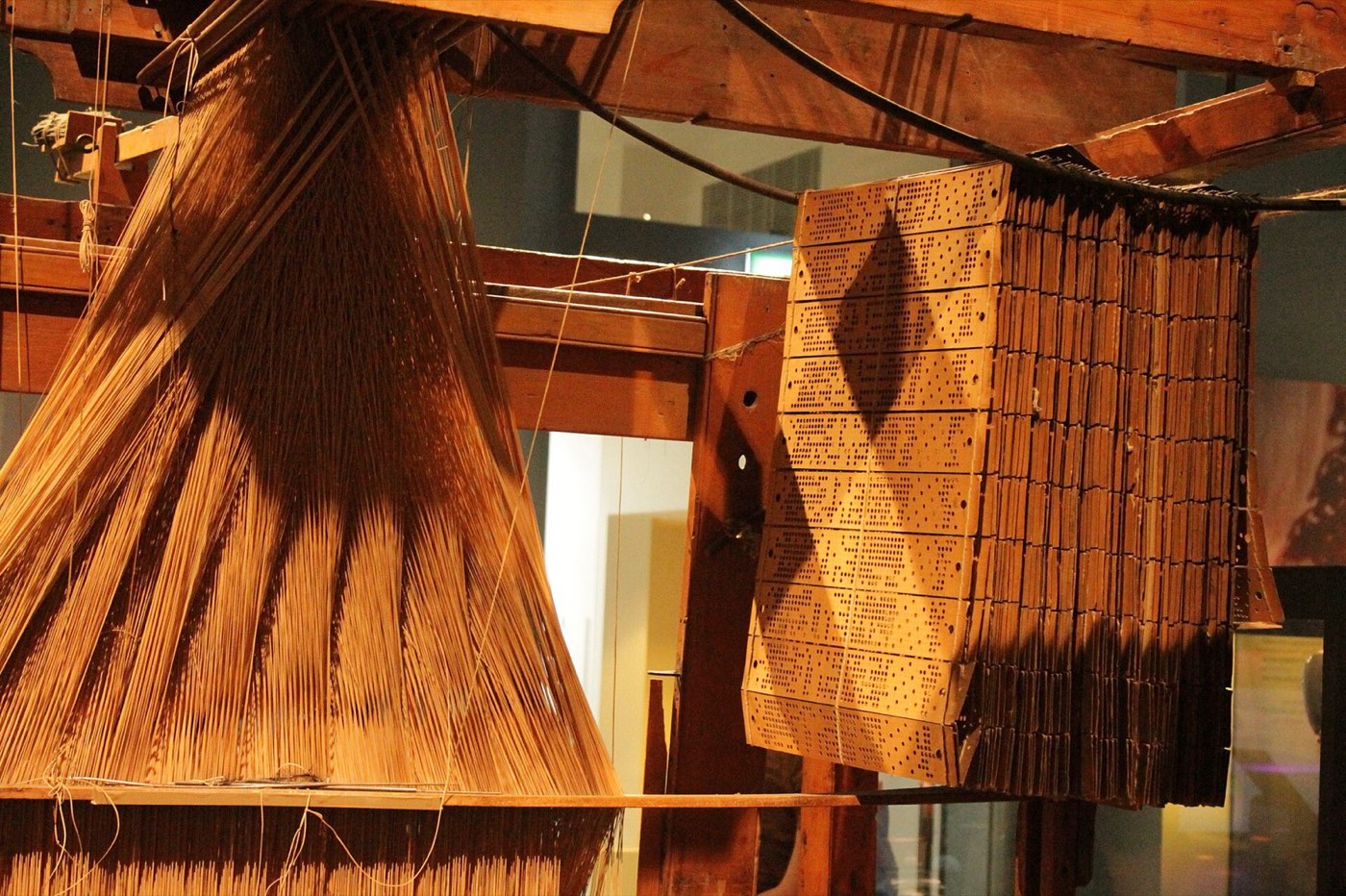
The machine now paints the mural, turns the sonnet, and scores the film.
We have, in short, realized Edward Bellamy’s technocratic utopia Looking Backward (1888)—the very book whose vision of centralized, hyper-efficient industrial socialism provoked Morris to write News from Nowhere in incandescent rebuttal—yet we have stripped Bellamy’s world of even its dreary egalitarianism. Bellamy’s future was a sterilized paradise of pneumatic tubes, conscripted labor armies, and frictionless consumer distribution, in which work was treated as an unpleasant tax to be minimized by administrative genius so that citizens might retire early to passive consumption. Silicon Valley’s accelerationist gospel merely privatizes Bellamy’s dream: it promises an algorithmic cornucopia of infinite, zero-marginal-cost content while quietly starving the human sensorium of the dignity of making. Morris saw through the fallacy a century and a half before the first neural network was trained. A civilization that abolishes the necessity of creative effort in order to maximize passive consumption has not liberated its citizens; it has infantilized them.
IIIThe Ontology of Friction: Ruskin, the Fallible Hand, and the Hyper-Scraped Artifact
Yet the deepest crisis that artificial intelligence poses to Morris’s worldview is not merely economic; it is ontological. To understand why an algorithmically generated tapestry or sonnet feels subtly, uncannily hollow—even when its formal geometry is technically unimpeachable—one must return to John Ruskin’s foundational chapter The Nature of Gothic in The Stones of Venice, a text Morris revered as “one of the very few necessary and inevitable utterances of the century” and reprinted at his own Kelmscott Press in 1892.
For Ruskin, and for Morris after him, the moral glory of the medieval cathedral lay not in the sterile perfection of its proportions, which the classical Greek temple or the mechanized factory could rival, but in its savageness, its changefulness, its visible, unapologetic imperfection. Look closely at the carved capitals of a Gothic nave, Ruskin urged, and you will find beasts that are slightly asymmetrical, foliage that wanders off its axis, grotesques that betray the idiosyncratic humor or fatigue of an anonymous stonemason. Those irregularities are not defects to be smoothed away by quality control; they are the legible indices of human freedom. A slave can be whipped into carving a perfectly uniform classical egg-and-dart molding; only a free consciousness, negotiating the stubborn grain of limestone in real time, produces the living, slightly crooked miracle of Gothic ornament.
An artifact, in this ontology, is not merely a visual configuration of surfaces; it is congealed intentionality—the material record of a mortal creature’s encounter with recalcitrant matter. When Morris plunged his arms into the indigo vat at Merton Abbey until his forearms were stained permanently blue, or wrestled with the dense, architectural blackness of his bespoke Troy and Chaucer types on dampened handmade rag paper for the 1896 Kelmscott Chaucer, the resistance of the medium was not an obstacle to be eliminated. The resistance was the point. Friction is the crucible in which vague impulse becomes realized form; without the pushback of wood, wool, ink, or syntax, the maker never truly discovers what the thing is trying to become.
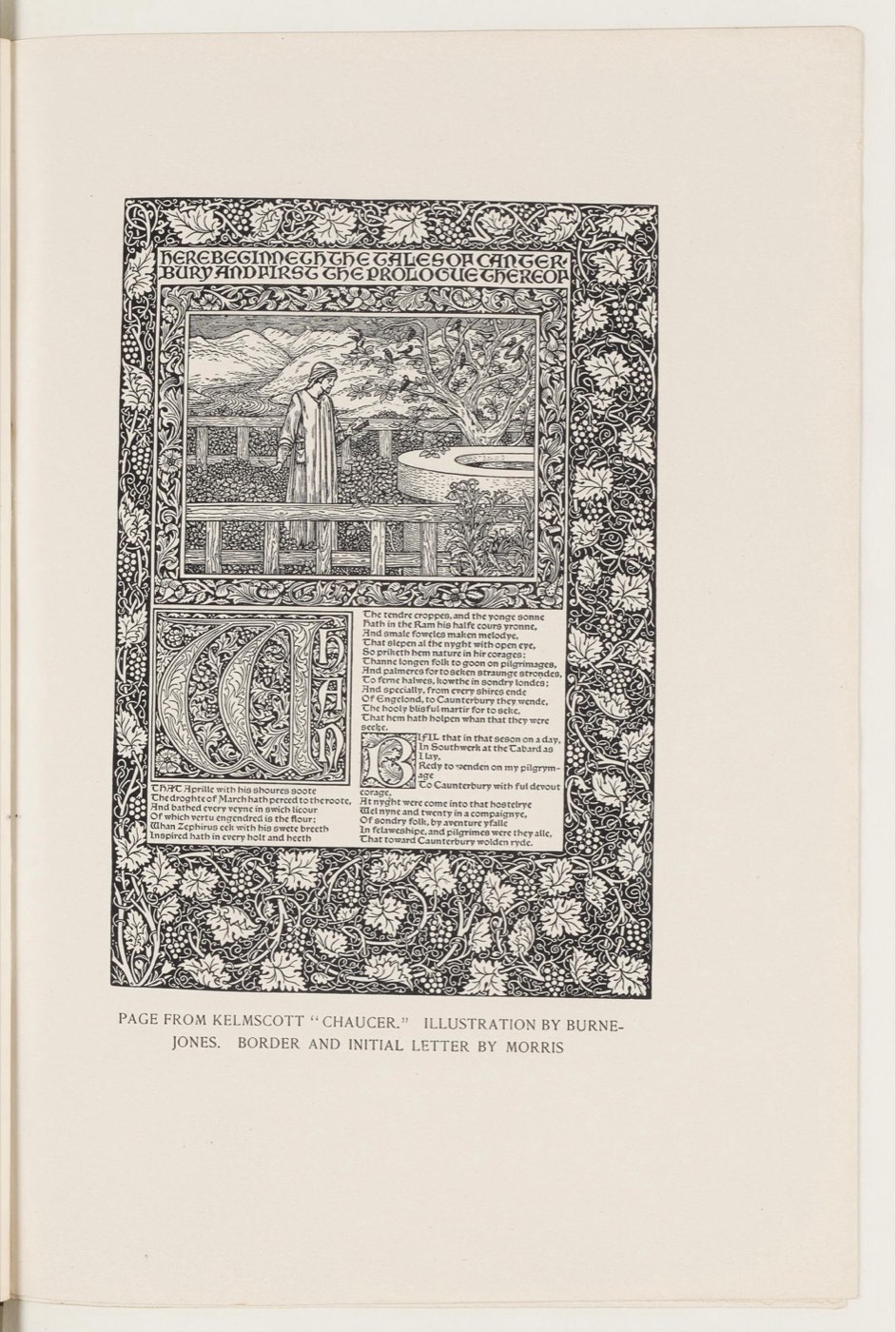
Friction is the crucible in which vague impulse becomes realized form.
Generative AI, by contrast, is the metaphysical apotheosis of what Morris’s Society for the Protection of Ancient Buildings—colloquially and deliciously dubbed “Anti-Scrape”—fought to the death. In 1877, horrified by Victorian architects like Sir George Gilbert Scott, who ruthlessly “restored” medieval churches by scraping away centuries of weathered stonework, Tudor additions, and eccentric repairs in order to impose a sterile, conjectured thirteenth-century purity, Morris drafted the SPAB manifesto. A building, he argued, is not a static blueprint to be perpetually reset to an idealized factory state; it is a palimpsest of collective human labor and lived time. To scrape away its patina in the name of formal perfection is to murder its historical soul and replace a living witness with a lifeless forgery.
What is a foundation model if not a planetary-scale Anti-Scrape engine operating in reverse? It ingests the vast, heterogeneous palimpsest of human cultural labor—millennia of woodcuts, essays, oil paintings, folktales, architectural drawings, and personal confessions—dissolves their historical specificity, material struggle, and biographical provenance into a smooth, continuous statistical manifold, and extrudes an eerily frictionless, ahistorical counterfeit. The output is hyper-scraped. It exhibits the superficial morphology of craft—the gilded serif, the Pre-Raphaelite gaze, the painterly impasto, the balanced periodic sentence—whilst remaining wholly devoid of the finite, mortal expenditure of time that gives form its ethical gravity.
Walter Benjamin famously observed that mechanical reproduction withers the aura of the artwork—its unique presence in time and space, its embeddedness in the fabric of tradition. Algorithmic generation goes a fatal step further: it does not merely reproduce an existing aura until it thins into wallpaper; it simulates the symptoms of aura without an original ever having existed. It offers us the patina without the passage of time, the brushstroke without the wrist, the lamentation without the grief. In Morris’s vocabulary, this is the ultimate triumph of “shoddy”—not merely cheap goods that fall apart in the rain, but an epistemic shoddiness that degrades our very capacity to distinguish between a living utterance and a statistical echo.
IVThe Kelmscott Paradox and the New “Swinish Luxury”
Yet a truly Morrisian dialectic cannot terminate in mere aristocratic lamentation, nor in the smug nostalgia of the connoisseur who congratulates himself for preferring letterpress broadsides to large language models. To indulge in that posture is to fall headlong into the very bourgeois trap that tormented Morris throughout the middle decades of his life—a trap he had the rare intellectual honesty to diagnose in himself.
The central tragedy of Morris & Co., and the catalyst of Morris’s political radicalization, was his piercing recognition that his own workshop had been captured by the very class whose aesthetic philistinism he loathed. Hand-blocked wallpapers, vegetable-dyed Arras tapestries, and bespoke stained glass required immense investments of skilled human time; within a capitalist market, they were necessarily priced far beyond the reach of the working class whose lives Morris hoped to beautify. The irony was excruciating: in attempting to resurrect an art “made by the people and for the people, as a happiness to the maker and the user,” Morris found himself furnishing the country estates of industrial magnates and Tory peers. When an aristocratic client once complained of the expense of his wares, Morris famously erupted that he spent his life “ministering to the swinish luxury of the rich.” It was this unsparing self-critique—the realization that ethical consumption and artisanal workshops can never reform a mode of production from within—that propelled him across what he called the “river of fire” into the Socialist League and the grueling study of Marx’s Das Kapital.
We are already witnessing the exact structural recapitulation of the Kelmscott paradox in the age of AI. As synthetic media, automated prose, and algorithmically optimized design flood the public sphere at near-zero cost, a stark, dystopian class bifurcation is beginning to crystallize. For the vast majority—the digital proletariat—there will be the algorithmic commons: AI-generated textbooks in underfunded schools, AI-drafted medical and legal triage, AI-composed background music, AI-rendered illustrations, and an endless, narcotizing feed of personalized synthetic slop engineered to maximize engagement while minimizing human labor costs. Meanwhile, for the affluent intelligentsia and the capital-owning elite, “human-made” is rapidly being rebranded as the ultimate luxury signifier: small-batch journalism written by named essayists, hand-bound books, live unamplified music, bespoke architectural craft, and human-taught seminars—all purchased at a steep premium precisely to signal insulation from the automated mediocrity of the masses.
If our response to artificial intelligence amounts to nothing more than a boutique “human-made” certification sticker—an artisanal shelter for those who can afford to opt out of the synthetic deluge—then we will have learned nothing from Morris’s crossing of the river of fire. Morris would look upon a world where human creativity is preserved solely as a Veblen good for the wealthy with the same thunderous contempt he reserved for his own showroom. The problem is not merely that AI produces ugly or soulless things; the problem is who owns the computational means of production, whose labor was expropriated without consent to train the weights, and what social order decides that human expression is an inefficiency to be optimized away for the many while hoarded as a status marker for the few.
VThe Migration of Craft? Conception, Execution, and the Ghost in the Studio
Intellectual honesty, however, demands that we confront the most formidable counter-argument to the orthodox Morrisian critique—a contrarian dialectic that any serious student of aesthetics and technology must weigh without flinching.
Suppose an interlocutor were to challenge Morris thus: You mistake the tool for the alienation. Every new medium in the history of art—from the printing press to the camera to the cinema to the synthesizer—was initially denounced as the death of craft, because it automated a manual skill previously held sacred. Yet in each instance, craft did not perish; it migrated. The photographer did not grind pigments or mix egg tempera, yet photography developed its own exacting disciplines of framing, light, timing, and chemical darkroom judgment. The film director does not physically paint twenty-four frames per second, yet cinema became the cathedral art of the twentieth century. Why, then, should we assume that the age of AI abolishes the artisan, rather than relocating craft from the level of manual execution to the level of architectural intent, discriminating taste, system design, and relentless curation?
It is a seductive, sophisticated argument, and it captures something undeniably real about how ambitious makers already work with generative systems. There is a vast gulf between the passive consumer who types a lazy one-line prompt and accepts the first glossy cliché the model regurgitates, and the obsessive designer, coder, or writer who wrestles with the instrument—refusing its statistical defaults, constraining its latent space, iterating across hundreds of revisions, curating and assembling fragments into a coherent, idiosyncratic whole that reflects a singular human sensibility. In such hands, the model appears less like an autonomous replacement for the artist and more like a vast, unruly studio of assistants—a Rubens workshop in silicon—requiring a fierce, discerning master to impose aesthetic law upon the chaos.
Yet Morris would not surrender easily to this defense; in fact, he had already anticipated and dismantled its underlying premise in his fierce attacks on the nineteenth-century division of labor. For Morris, the fatal rot of modern art began precisely during the Renaissance, when the unified figure of the master-builder—who both conceived the cathedral and knew the feel of the chisel in his own palm—was split into two alienated castes: the “gentleman architect” in his clean studio, who drew abstract elevations on paper, and the “mere mechanic” on the scaffolding, reduced to executing someone else’s specifications without agency or delight.
Even when the “gentleman prompter” exercises exquisite, tyrannical taste over an algorithmic studio, Morris would insist that something vital has been amputated. To separate conception from execution is to assume that thought happens wholly inside the skull, and that the body’s physical engagement with the medium is merely a tedious delivery mechanism to be delegated away. Anyone who has ever written a sentence by hand, thrown clay on a wheel, or debugged a stubborn piece of architecture knows this is a Cartesian illusion. We do not merely execute ideas we already possess; we think through the resistance of the material. The unexpected snag in the wool, the stubborn metrical foot that refuses to scan, the accidental bleed of ink across wet paper—these micro-frictions continually derail our preconceived intentions and force us into discoveries we could never have specified in advance.
When we delegate execution to a probabilistic oracle that completes our half-formed thoughts with smooth, plausible competence, we risk quietly atrophying the very faculty of judgment we claim to be elevating. Taste, after all, is not a disembodied aristocracy of the eye; it is educated by the humbling, intimate knowledge of how things are actually made. A generation that curates everything and crafts nothing may soon find that its curation itself has grown weightless, unmoored from the material intelligence that once taught it what to love and what to refuse.
VIThe Ecological Cathedral and the Politics of Enough: News from Nowhere Revisited
There is one final dimension of Morris’s thought that renders him startlingly, almost prophetically contemporary in the era of hyperscale AI: his radical ecological consciousness. Long before “sustainability” was laundered into corporate ESG brochures, Morris understood that industrial capitalism’s war on human labor was inseparable from its war on the living earth. His letters and lectures are saturated with a visceral, aching grief for the soot-blackened skies of Manchester, the chemically poisoned rivers of the Midlands, and the relentless sprawl of jerry-built suburbs devouring the English countryside. For Morris, ugliness and ecological devastation were twin symptoms of the same pathology: an economic engine structurally compelled toward infinite, purposeless accumulation.
Look, then, at the material substrate of our supposedly “immaterial” artificial intelligence. The cloud is not a cloud; it is an archipelago of windowless concrete fortresses squatting across arid plains, guzzling gigawatts of electricity, diverting millions of gallons of municipal water into evaporative cooling towers, and prompting the resurrection of shuttered coal and nuclear plants—all to sustain an arms race of exponential parameter growth and endless synthetic generation. We are burning the physical biosphere to manufacture an infinite supply of weightless images and disposable prose that no one asked for and few will ever read.
Against this feverish, extractive infinity, Morris’s News from Nowhere (1890) shines with a fierce, subversive radiance. Written as a serialized utopian romance in the pages of Commonweal, the novel transports its narrator, William Guest, into a twenty-second-century England after the socialist revolution. It is a world of breathtaking, almost scandalous restraint. The great industrial metropolises have dissolved into gardens and small, convivial settlements; the Thames runs clear enough for salmon to leap beneath Hammersmith Bridge; the Houses of Parliament have been repurposed, with wicked Morrisian glee, as a storage facility for dung. Most crucially, Nowhere is governed by what we might call a politics of enough. Because nobody profits from planned obsolescence or artificially manufactured desire, the inhabitants produce far fewer objects—but every pipe, every embroidered tunic, every carved bridge, and every communal hall is crafted to endure for generations, and to be repaired with affection when it wears.
In News from Nowhere, Morris names this post-revolutionary civilization “an epoch of rest.” By rest, he did not mean torpor or inertia; he meant liberation from the manic, accelerative panic of capital—the compulsion to optimize every second, scale every process, and monetize every crevice of human attention. In an age when the lords of Silicon Valley openly preach an eschatology of perpetual acceleration—insisting that we must sprint ever faster toward artificial general intelligence lest we be outpaced by rivals—Morris’s “epoch of rest” is the most radical political heresy imaginable. It asks the forbidden question: What if we do not want more, faster, cheaper, and frictionless? What if we want less, slower, truer, and our own?
What if we want less, slower, truer, and our own?
VIICoda: Indigo Hands in an Age of Weightless Light
William Morris died in October 1896, at the age of sixty-two, having lived ten lives in the span of one. His physician, baffled by the absence of any singular fatal pathology, famously remarked that the disease was “simply being William Morris, and having done more work than most ten men.” He left behind epic poems, Icelandic translations, socialist manifestos, architectural preservation campaigns, stained glass, tapestries, wallpapers, and the monumental Kelmscott Chaucer—a body of work united not by a cranky aversion to the future, but by an unyielding, almost ferocious devotion to the dignity of earthly life.

To summon Morris into the age of artificial intelligence is not to demand that we smash the servers, abandon computation, or retreat into pastoral cosplay. It is, rather, to re-anchor our technological debates in the only question that finally matters. The supreme crisis of AI is neither the velocity of its inference, nor the market capitalization of its proprietors, nor even the baroque, science-fictional eschatology of sentient machines turning upon their creators. It is a far older, far more stubbornly material question: what becomes of the human animal when the world is saturated with effortless simulations of beauty, and no one is left with the time, the necessity, the friction, or the joy of making anything real?
Against the weightless, infinite scroll of synthetic perfection—that smooth, hyper-scraped paradise hallucinated in the dark of the data center—William Morris still stands at his dye vat at Merton Abbey, indigo-stained to the elbows, smelling of madder root and damp wool. He does not offer us an easy escape from the machine, nor a comfortable truce with its masters. He offers us something far harder and far more enduring: a standard of human aliveness. An imperfect world wrought by free, fallible hands—slowly, stubbornly, and with love—remains infinitely more precious than a flawless kingdom dreamed up by a loom that cannot feel the thread.
The cloth this essay wove: one band per part, in the order you read them. End of essay No. 1.
The Master-Slave Dialectic of the Feed: Hegel, Kojève, and the Politics of Algorithmic Recognition
Next in this issue · Machines & Minds · Essay No. 2